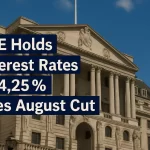
The Bank of England base rate plays a crucial role in determining the cost of borrowing and the returns on savings across the UK economy. Whether you’re a homeowner with a mortgage, a saver, or an investor, the base rate has a direct impact on your finances. In this article, we break down the current base rate, historical trends, and when the next review is expected.
Current Bank of England Base Rate (As of June 2025)
4.25% (Last updated on: 9 May 2025)
The Monetary Policy Committee (MPC) of the Bank of England maintained the base rate at 4.25% in its May 2025 meeting. This decision was based on persistent inflationary pressures and a cautious approach toward monetary easing.
Next Bank of England Base Rate Review
The next scheduled review of the BoE base rate will be held on:
Thursday, 20 June 2025
The Monetary Policy Committee typically meets every six weeks to assess economic conditions and determine if a rate change is necessary. These meetings are closely watched by financial analysts, lenders, and borrowers alike.
Historical Bank of England Base Rate (1990 – 2025)
Full Historical Bank of England Base Rate Data
Below is a comprehensive table showing all the changes in the BoE base rate from 1975 to 2025:
| Date Changed | Rate (%) |
|---|---|
| 08 May 25 | 4.25 |
| 06 Feb 25 | 4.50 |
| 07 Nov 24 | 4.75 |
| 01 Aug 24 | 5.00 |
| 03 Aug 23 | 5.25 |
| 22 Jun 23 | 5.00 |
| 11 May 23 | 4.50 |
| 23 Mar 23 | 4.25 |
| 02 Feb 23 | 4.00 |
| 15 Dec 22 | 3.50 |
| 03 Nov 22 | 3.00 |
| 22 Sep 22 | 2.25 |
| 04 Aug 22 | 1.75 |
| 16 Jun 22 | 1.25 |
| 05 May 22 | 1.00 |
| 17 Mar 22 | 0.75 |
| 03 Feb 22 | 0.50 |
| 16 Dec 21 | 0.25 |
| 19 Mar 20 | 0.10 |
| 11 Mar 20 | 0.25 |
| 02 Aug 18 | 0.75 |
| 02 Nov 17 | 0.50 |
| 04 Aug 16 | 0.25 |
| 05 Mar 09 | 0.50 |
| 05 Feb 09 | 1.00 |
| 08 Jan 09 | 1.50 |
| 04 Dec 08 | 2.00 |
| 06 Nov 08 | 3.00 |
| 08 Oct 08 | 4.50 |
| 10 Apr 08 | 5.00 |
| 07 Feb 08 | 5.25 |
| 06 Dec 07 | 5.50 |
| 05 Jul 07 | 5.75 |
Note: For complete data from 1975 onwards, visit the Bank of England Database.
This table highlights the volatility of the base rate in response to global events such as the financial crisis, Brexit, and post-pandemic inflation.
How the Base Rate Affects You
- Mortgages: A higher base rate usually increases mortgage repayments for those on variable or tracker rates.
- Savings Accounts: Banks may offer better interest rates on savings when the base rate is high.
- Loans and Credit Cards: Borrowing becomes more expensive with higher rates.
- Business Finance: Higher rates can reduce borrowing and investment activity among businesses.
Why Does the BoE Change the Base Rate?
The Bank of England uses the base rate as a tool to meet its primary objective: controlling inflation. When inflation rises above the 2% target, the MPC may increase the base rate to cool spending. When the economy slows or faces recession, the base rate may be cut to encourage borrowing and spending.
FAQs about Bank of England Base Rate
Q1: What is the base rate set by the Bank of England?
A: It’s the interest rate the BoE charges banks and lenders. It influences rates across mortgages, loans, and savings.
Q2: When is the next interest rate decision by the Bank of England?
A: The next decision is scheduled for 20 June 2025.
Q3: How often does the Bank of England review the base rate?
A: Typically every 6 weeks during the MPC meetings.
Q4: Can the base rate go below zero?
A: While rare, it is theoretically possible. The BoE considered negative rates during the COVID-19 crisis but did not implement them.
Q5: How does the base rate impact inflation?
A: A higher base rate reduces spending and borrowing, which can lower inflation.
Q6: Where can I track the latest BoE announcements?
A: On the official Bank of England website (https://www.bankofengland.co.uk/monetary-policy)
Final Thoughts
Understanding the Bank of England base rate helps UK residents make informed decisions about borrowing, saving, and investing. With inflation still a key concern, it’s vital to stay updated on upcoming rate reviews and economic signals.
Bookmark this page for the latest updates, expert analysis, and historical data on the BoE base rate
Disclaimer:
The information provided in this article is for general informational purposes only and should not be considered financial advice. While we strive to keep the content accurate and up to date, the Bank of England’s base rate and related data may change at any time. Readers are encouraged to consult the official Bank of England website or seek independent financial advice before making any financial decisions.